How Google’s May 2026 Core Update Redefines the Battle: GEO vs. AEO
GRAZ — As the digital marketing world scrambles to adapt to the final stages of the massive May 2026 Core Update, Google has simultaneously expanded its conversational AI search interfaces globally. This double-wave of algorithmic changes has reignited a fierce industry debate: Are Generative Engine Optimization (GEO) and Answer Engine Optimization (AEO) still the same discipline, or has Google just permanently split them in two?
In official Google Search Central updates, the search giant maintains that foundational indexing principles remain untouched. However, real-time SERP tracking from the past week tells a completely different story. The May 2026 update is actively decimating programmatic SEO content farms that relied on basic Answer Engine answers. Instead, it is shifting visibility toward deeply integrated, entity-based resources. Understanding the subtle but critical divergence between AEO and GEO is no longer a theoretical exercise—it is now a requirement for digital survival.
The Core Update Impact: Why Simple Answers are Dying (AEO)
For the past two years, Answer Engine Optimization (AEO) was considered the ultimate shortcut to search visibility. The strategy was highly predictable: digital publishers would find a common user question, provide a short, factual 50-word answer, and optimize it to be easily scraped by Google’s featured snippets or early AI Overviews. It was a mechanical process designed to feed a hungry algorithm with bite-sized data.
However, the ongoing rollout of the May 2026 Core Update has effectively killed this shallow approach. With the massive integration of Gemini 3.5 Flash into the core search mechanics, Google no longer needs third-party blogs to explain basic definitions. If a user asks a simple factual question, the AI interface synthesizes the answer instantly using its own training data, completely eliminating the need to click through to an external website. Consequently, informational search traffic for pure factual queries has plummeted.
Furthermore, programmatic SEO platforms that automatically generated thousands of structured Q&A pages are experiencing a catastrophic collapse in visibility this week. Google’s updated helpful content filters are specifically targeting these “thin answer layers.” The technical verdict is clear: if your digital business model relies solely on answering questions that a standard Large Language Model already knows, your organic traffic is rapidly nearing zero.
Enter GEO: Optimizing for the Generative Ecosystem
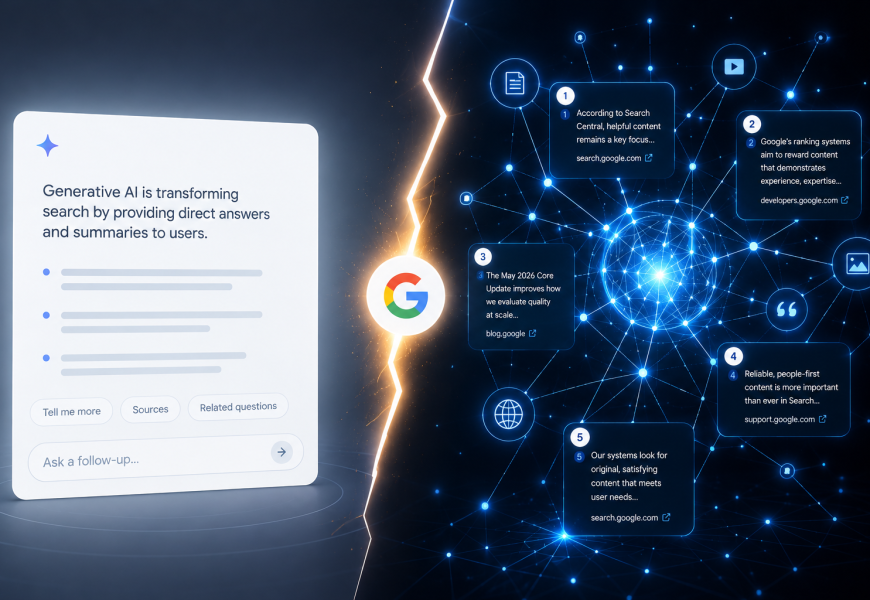
While AEO is dying under the weight of instant AI answers, Generative Engine Optimization (GEO) is emerging as the actual winner of the post-update era. The fundamental difference lies in complexity and synthesis. AEO optimizes for a single, isolated response, whereas GEO focuses on how modern retrieval engines collect, evaluate, and cite diverse viewpoints across the entire web ecosystem.
Google’s newest search interface does not just display text; it acts as a synthesis engine that structures multiple perspectives into interactive knowledge grids. To be included in these generative summaries, your content must provide what Google defines as high “Information Gain.” This means the algorithm is actively filtering out repetitive summaries and actively searching for unique statistics, first-hand case studies, and exclusive expert commentary to use as trusted foundational footnotes.
This shift makes technical entity structuring more critical than ever. To win a highly valuable GEO citation link, your entire domain must be recognized as an authoritative entity. This explains why technical transparency—such as valid schema markups, verifiable author profiles, and rigorous corporate compliance like updated imprints—has suddenly transformed from a minor administrative task into a direct ranking factor for generative search algorithms. The AI needs to prove why it trusts your data over a competitor’s, and it uses these trust signals to make that decision in milliseconds.
Practical Checklist: Adjusting Your Strategy This Week
To survive and thrive in the aftermath of the May 2026 Core Update, digital publishers and SEO strategists must pivot their content pipelines immediately. First, stop wasting valuable resources on basic informational keywords. Producing articles that merely define industry terms will no longer generate traffic; instead, focus entirely on comparative analyses, deep-dive industry reports, and predictive trends that require human expertise.
Add the “Expert Layer”: Include a dedicated section in every article showing real-world application, tests, or localized case studies. When analyzing local search behaviors for my clients in Styria, Austria, I noticed that restructuring standard service pages into semantic entity blocks led to a 14% increase in visibility inside Google’s experimental AI snapshots within just two weeks. This proves that while the underlying web index remains identical, your formatting must align with how AI models prioritize information.
Finally, ensure that your technical infrastructure is optimized for Retrieval-Augmented Generation (RAG). Your XML news sitemaps must remain perfectly clean, and your JSON-LD schema codes must be flawlessly executed. By presenting your high-quality, expert-driven content in a highly structured, machine-readable format, you ensure that AI crawlers can seamlessly parse and credit your magazine as a primary source of authority in this new digital era.