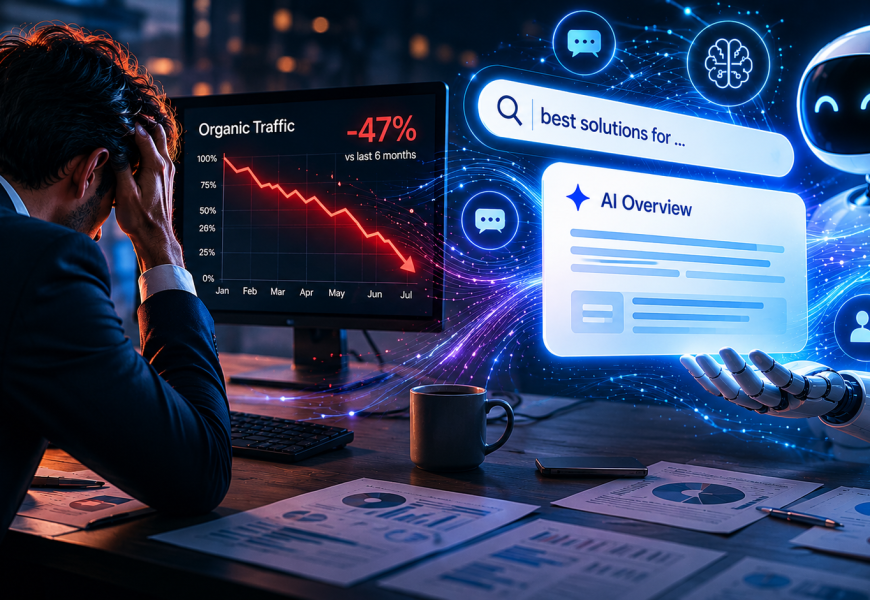
The way people find information online is changing fundamentally. For companies that rely on steady website traffic to generate leads, acquire new clients, or drive digital revenue, a digital storm is brewing.
This disruption is driven by zero-click searches (search queries that end without a click), fueled by the rapid rise of AI search engines like Google AI Overviews, Perplexity, and ChatGPT Search.
If you want your business to remain visible and attract customers in the coming years, you need to understand the new rules of the AI era.
The New Reality: Searching Without Clicking
AI search engines break this system entirely. Instead of presenting a list of blue links, AI models crawl web content in seconds, synthesize it, and deliver a tailored answer directly on the search results page.
A Dwindling Lead Pipeline
When informational blog posts, guides, or product comparisons are answered instantly by AI, top-of-funnel traffic disappears. It becomes much harder to capture potential clients early in their buyer journey.
The Visibility Monopoly
Traditional search allowed businesses to compete for the top ten spots. AI answers, however, aggregate information from just two or three top sources [forbes, land]. If the AI does not explicitly cite your website as a trusted source, your business practically ceases to exist in the mind of the user
Diluted Brand Identity
AI blends your unique data and arguments with your competitors' content into a generic summary. Your distinct brand voice and corporate identity get lost in translation.
Why Traditional SEO Is No Longer Enough
The Solution: Shifting from SEO to GEO (Generative Engine Optimization)
- Structuring Information for LLMs: Formatting your content so that Large Language Models can flawlessly extract your core arguments.
- Building Brand Authority (AI Mentions): The more your brand is mentioned positively across the web within your niche, the more likely the AI is to trust you as an expert source.
- Focusing on E-E-A-T and Uniqueness: AI summarizes mainstream knowledge perfectly [gartner]. However, it cannot replicate real-world case studies, proprietary data, and deep human expertise. GEO ensures these unique elements take center stage.